- Home
- Departments
- Stormwater
- Resources
- Riparian Buffer Information & Resources
Riparian Buffer Information & Resources
Why Protect Riparian Buffers
Riparian buffers provide numerous environmental and recreational benefits to streams, groundwater, and downstream land areas. All landowners (individuals, businesses, and municipalities) should make every effort to preserve riparian buffers and improve them. Existing buffers can be protected through requirements, easement agreements, or simply through a conscious effort to decrease mowing and maintain trees and shrubs.
Why Restore Riparian Buffers
In addition to protecting existing buffers, research has shown that stream damage can be minimized and water quality enhanced by installing riparian buffers where they have been previously removed. Landowners can plant trees and shrubs in areas where there is a gap in the riparian buffer to begin a restoration project. However, most plans to restore a riparian buffer involve more than just planting trees and should be coordinated with the local municipality and an agency experienced with stream restoration practices.
Benefits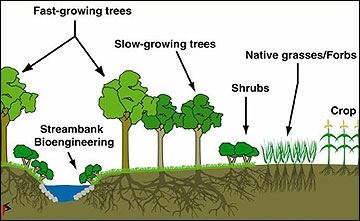
Research has identified numerous benefits to protecting and restoring riparian buffer areas. Buffers have been found to: increase groundwater infiltration, provide cooler water and air temperatures, decrease streambank erosion glossary, filter sediments and pollutants commonly found in runoff, provide floodwater storage, increase wildlife habitat, and provide recreation areas.
Cost
There is little or no cost involved in protecting existing riparian buffers. Restoring forested buffers requires an initial investment in plant materials, tools, and labor. However, the long-term cost savings due to decreased mowing requirements for a restored buffered area can be quite significant.
Maintenance
Watering new plantings and removing invasive weeds are the primary maintenance requirements for restored riparian buffers. Ongoing maintenance activities for all buffers may include selective cutting and/or pruning and replanting bare spots or unsuccessful trees and shrubs. Riparian buffer areas should not be mowed frequently -only about once per year for newly created buffer areas. Existing, mature riparian areas should require no mowing at all.
Materials
Trees, shrubs, and wetland grasses can all be used to restore or enhance a riparian buffer area. See the list of recommended plants below.
Suggested Plants
Native vegetation should be used whenever possible to restore a riparian buffer.
Trees
American beech (Fagus grandifolia), Black willow (Salix nigra), Pagoda dogwood (Cornus alternifolia), Pin oak (Quercus palustris), Red maple (Acer rubrum), River birch (Betula nigra), Tulip tree (Liriodendron tulipifera)
Shrubs
American elderberry (Sambucus canadensis), Arrowwood (Viburnum dentatum), Buttonbush (Cephalanthus occidentalis), Highbush blueberry (Vaccinium corymbosum), Red chokeberry (Aronia arbutifolia), Silky dogwood (Cornus racemosa) Witch-hazel (Hamamelis virginiana)
Grasses & Sedges
Big blue stem (Andropogon geradii), Broom sedge (Carex scoparia), Riverbank wild rye (Elymus riparius), Soft rush (Juncus effusus) Switch grass (Panicum virgatum)
Perennial Flowers
Beard-tongue (Penstemon digitalis), Blue vervain (Verbena hastata), Cardinal flower (Lobelia cardinalis), Ironweed (Vernonia noveboracensis), New England Aster (Aster novae-angliae), Swamp milkweed (Asclepias incarnata)
Online Resources for Riparian Buffers
- Purpose of Riparian Buffers (PDF)
- Pennsylvania Stream Releaf Riparian Buffer Toolkit
- Stroud Water Research Riparian Information
- Partnership for the Delaware Estuary Stream Restoration: A multi-watershed organization to clean the Delaware Bay, including the White Clay, and Red Clay watersheds)
- Tree Vitalize: A partnership to restore tree cover to Pennsylvania communities.